Ojibwe Art Ojibwe Art How Did They Make Weapons
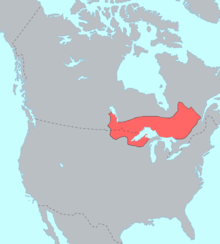 Precontact distribution of Ojibwe-speaking people | |
| Full population | |
|---|---|
| 170,742 in United States (2010)[i] 160,000 in Canada (2014)[two] | |
| Regions with significant populations | |
| Canada (Quebec, Ontario, Manitoba, Saskatchewan, Alberta) Us (Michigan, Wisconsin, Minnesota, North Dakota) | |
| Languages | |
| English language, Ojibwe, French | |
| Religion | |
| Midewiwin, Catholicism, Methodism | |
| Related indigenous groups | |
| Odawa, Potawatomi, Saulteaux, Oji-Cree, and other Algonquian peoples |
| Person | Ojibwe |
|---|---|
| People | Ojibweg |
| Language | Ojibwemowin |
| Land | Ojibwewaki |
The Ojibwe, Ojibwa, Chippewa, or Saulteaux are an Anishinaabe people in what is currently southern Canada, the northern Midwestern United States, and Northern Plains.
According to the U.Due south. census, in the U.s. Ojibwe people are one of the largest tribal populations among Native American peoples. In Canada, they are the second-largest Get-go Nations population, surpassed only by the Cree. They are one of the virtually numerous Indigenous Peoples north of the Rio Grande.[iii] [ better source needed ] The Ojibwe population is approximately 320,000 people, with 170,742 living in the United States as of 2010[update],[1] and approximately 160,000 living in Canada.[two] In the Us, there are 77,940 mainline Ojibwe; 76,760 Saulteaux; and 8,770 Mississauga, organized in 125 bands. In Canada, they alive from western Quebec to eastern British Columbia.
The Ojibwe language is Anishinaabemowin, a branch of the Algonquian language family.
They are role of the Council of Three Fires (which as well include the Odawa and Potawatomi) and of the larger Anishinaabeg, which likewise include Algonquin, Nipissing, and Oji-Cree people. Historically, through the Saulteaux branch, they were a function of the Iron Confederacy with the Cree, Assiniboine, and Metis.[iv]
The Ojibwe are known for their birchbark canoes, birchbark scrolls, mining and trade in copper, every bit well equally their cultivation of wild rice and maple syrup.[5] [ failed verification ] Their Midewiwin Society is well respected as the keeper of detailed and circuitous scrolls of events, oral history, songs, maps, memories, stories, geometry, and mathematics.[6] [ failed verification ]
European powers, Canada, and the U.s. have colonized Ojibwe lands. The Ojibwe signed treaties with settler leaders to give up country for settlement in exchange for compensation, land reserves and guarantees of traditional rights. Many European settlers moved into the Ojibwe bequeathed lands.[7]
Etymology [edit]
The exonym for this Anishinaabe group is Ojibwe (plural: Ojibweg). This name is commonly anglicized every bit "Ojibwa" or "Ojibway". The name "Chippewa" is an alternative anglicization. Although many variations exist in the literature, "Chippewa" is more common in the United states of america, and "Ojibway" predominates in Canada,[8] but both terms are used in each country. In many Ojibwe communities throughout Canada and the U.S. since the belatedly 20th century, more members have been using the generalized name Anishinaabe(-thou).
The meaning of the name Ojibwe is not known; the well-nigh mutual explanations for the name derivations are:
- ojiibwabwe (/o/ + /jiibw/ + /abwe/), significant "those who cook/roast until it puckers", referring to their fire-curing of moccasin seams to brand them waterproof.[9] Some 19th century sources say this proper noun described a method of ritual torture that the Ojibwe applied to enemies.[ten] [ page needed ]
- ozhibii'iwe (/o/ + /zhibii'/ + /iwe/), meaning "those who go along records [of a Vision]", referring to their form of pictorial writing, and pictographs used in Midewiwin sacred rites;[11] or
- ojiibwe (/o/ + /jiib/ + /we/), meaning "those who speak stiffly" or "those who stammer", an exonym or proper name given to them by the Cree, who described the Ojibwe language for its differences from their own.[12]
Because many Ojibwe were formerly located around the outlet of Lake Superior, which the French colonists chosen Sault Ste. Marie for its rapids, the early Canadian settlers referred to the Ojibwe as Saulteurs. Ojibwe who subsequently moved to the prairie provinces of Canada have retained the name Saulteaux. This is disputed since some scholars believe that only the name migrated due west.[thirteen] [ folio needed ] Ojibwe who were originally located along the Mississagi River and made their way to southern Ontario are known equally the Mississaugas.[14]
Language [edit]
The Ojibwe language is known as Anishinaabemowin or Ojibwemowin, and is still widely spoken, although the number of fluent speakers has declined sharply.[15] Today, almost of the language's fluent speakers are elders. Since the early 21st century, there is a growing movement to revitalize the language and restore its strength as a central function of Ojibwe culture. The language belongs to the Algonquian linguistic grouping and is descended from Proto-Algonquian. Its sister languages include Blackfoot, Cheyenne, Cree, Fox, Menominee, Potawatomi, and Shawnee among the northern Plains tribes. Anishinaabemowin is frequently referred to as a "Fundamental Algonquian" language; Central Algonquian is an area grouping, withal, rather than a linguistic genetic one.
Ojibwemowin is the 4th-nearly spoken Native language in Due north America after Navajo, Cree, and Inuktitut. Many decades of fur trading with the French established the language as one of the cardinal merchandise languages of the Cracking Lakes and the northern Great Plains.
The popularity of the ballsy poem The Song of Hiawatha, written by Henry Wadsworth Longfellow in 1855, publicized the Ojibwe culture. The epic contains many toponyms that originate from Ojibwe words.
History [edit]
Precontact and spiritual beliefs [edit]
According to Ojibwe oral history and from recordings in birch bawl scrolls, the Ojibwe originated from the mouth of the Saint Lawrence River on the Atlantic coast of what is now Quebec.[16] They traded widely beyond the continent for thousands of years as they migrated, and knew of the canoe routes to motility north, west to east, then s in the Americas. The identification of the Ojibwe as a culture or people may have occurred in response to contact with Europeans. The Europeans preferred to bargain with groups, and tried to identify those they encountered.[17]
According to Ojibwe oral history, seven great miigis (Cowrie shells) appeared to them in the Waabanakiing (Land of the Dawn, i.e., Eastern Country) to teach them the mide way of life. One of the miigis was too spiritually powerful and killed the people in the Waabanakiing when they were in its presence. The vi others remained to teach, while the 1 returned into the sea. The six established doodem (clans) for people in the east, symbolized by animals. The five original Anishinaabe doodem were the Wawaazisii (Bullhead), Baswenaazhi (Echo-maker, i.e., Crane), Aan'aawenh (Pintail Duck), Nooke (Tender, i.e., Behave) and Moozoonsii (Footling Moose). The half-dozen miigis and then returned to the ocean besides. If the seventh had stayed, it would accept established the Thunderbird doodem.
At a subsequently time, ane of these miigis appeared in a vision to relate a prophecy. Information technology said that if the Anishinaabeg did non movement further west, they would non be able to keep their traditional ways alive because of the many new pale-skinned settlers who would arrive soon in the east. Their migration path would be symbolized by a series of smaller Turtle Islands, which was confirmed with miigis shells (i.east., cowry shells). After receiving assurance from their "Centrolineal Brothers" (i.e., Mi'kmaq) and "Begetter" (i.eastward., Abenaki) of their safety to motion inland, the Anishinaabeg gradually migrated westward along the Saint Lawrence River to the Ottawa River to Lake Nipissing, and so to the Nifty Lakes.
The first of the smaller Turtle Islands was Mooniyaa, where Mooniyaang (present-twenty-four hours Montreal) [18] developed. The "2nd stopping place" was in the vicinity of the Wayaanag-gakaabikaa (Concave Waterfalls, i.e., Niagara Falls). At their "third stopping place", near the present-24-hour interval city of Detroit, Michigan, the Anishinaabeg divided into six groups, of which the Ojibwe was 1.
The first pregnant new Ojibwe culture-heart was their "fourth stopping identify" on Manidoo Minising (Manitoulin Isle). Their first new political-center was referred to as their "fifth stopping identify", in their present country at Baawiting (Sault Ste. Marie). Standing their w expansion, the Ojibwe divided into the "northern branch", post-obit the n shore of Lake Superior, and the "southern co-operative", along its s shore.
As the people connected to migrate westward, the "northern branch" divided into a "westerly group" and a "southerly group". The "southern branch" and the "southerly group" of the "northern co-operative" came together at their "6th stopping place" on Spirit Island ( 46°41′xv″N 092°11′21″W / 46.68750°N 92.18917°Westward / 46.68750; -92.18917 ) located in the Saint Louis River estuary at the western cease of Lake Superior. (This has since been developed equally the present-twenty-four hour period Duluth/Superior cities.) The people were directed in a vision by the miigis being to get to the "identify where there is nutrient (i.e., wild rice) upon the waters." Their 2nd major settlement, referred to equally their "seventh stopping place", was at Shaugawaumikong (or Zhaagawaamikong, French, Chequamegon) on the southern shore of Lake Superior, most the nowadays La Pointe, Wisconsin.
The "westerly group" of the "northern branch" migrated along the Rainy River, Red River of the North, and across the northern Smashing Plains until reaching the Pacific Northwest. Along their migration to the west, they came across many miigis, or cowry shells, every bit told in the prophecy.
Contact with Europeans [edit]
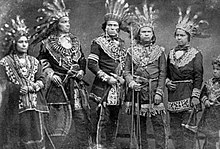
V Ojibwe chiefs in the 19th century.
The get-go historical mention of the Ojibwe occurs in the French Jesuit Relation of 1640, a report by the missionary priests to their superiors in France. Through their friendship with the French traders (coureurs des bois and voyageurs), the Ojibwe gained guns, began to apply European goods, and began to boss their traditional enemies, the Lakota and Trick to their west and south. They drove the Sioux from the Upper Mississippi region to the area of the present-day Dakotas, and forced the Trick down from northern Wisconsin. The latter allied with the Sauk for protection.
By the end of the 18th century, the Ojibwe controlled about all of present-day Michigan, northern Wisconsin, and Minnesota, including most of the Cerise River area. They also controlled the unabridged northern shores of lakes Huron and Superior on the Canadian side and extending w to the Turtle Mountains of North Dakota. In the latter area, the French Canadians chosen them Ojibwe or Saulteaux.
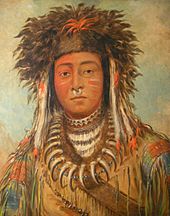
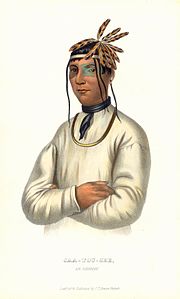
An Ojibwe named Boy Main, past the noted American painter George Catlin, who made portraits at Fort Snelling in 1835. In 1845 he traveled to Paris with xi Ojibwe, who had their portraits painted and danced for King Louis Philippe.
The Ojibwe were part of a long-term alliance with the Anishinaabe Odawa and Potawatomi peoples, called the Council of 3 Fires. They fought against the Iroquois Confederacy, based mainly to the southeast of the Smashing Lakes in present-day New York, and the Sioux to the due west. The Ojibwa stopped the Iroquois advance into their territory almost Lake Superior in 1662. Then they formed an alliance with other tribes such every bit the Huron and the Odawa who had been displaced by the Iroquois invasion. Together they launched a massive counterattack against the Iroquois and drove them out of Michigan and southern Ontario until they were forced to flee back to their original homeland in upstate New York. At the aforementioned time the Iroquois were subjected to attacks past the French. This was the beginning of the end of the Iroquois Confederacy every bit they were put on the defensive. The Ojibwe expanded e, taking over the lands along the eastern shores of Lake Huron and Georgian Bay.
In 1745, they adopted guns from the British in order to repel the Dakota people in the Lake Superior area, pushing them to the south and west. In the 1680s the Ojibwa defeated the Iroquois who dispersed their Huron allies and trading partners. This victory allowed them a "gilded age" in which they ruled uncontested in southern Ontario.[19]
Often, treaties known as "peace and friendship treaties" were made to establish community bonds between the Ojibwe and the European settlers. These established the groundwork for cooperative resource-sharing between the Ojibwe and the settlers. The United States and Canada viewed later treaties offer land cessions as offer territorial advantages. The Ojibwe did non understand the land cession terms in the same way because of the cultural differences in agreement the uses of land. The governments of the U.S. and Canada considered land a article of value that could exist freely bought, endemic and sold. The Ojibwe believed it was a fully shared resource, along with air, water and sunlight—despite having an understanding of "territory". At the time of the treaty councils, they could not conceive of split country sales or exclusive ownership of land. Consequently, today, in both Canada and the U.S., legal arguments in treaty-rights and treaty interpretations often bring to lite the differences in cultural understanding of treaty terms to come to legal understanding of the treaty obligations.[20]

In part considering of its long trading alliance, the Ojibwe allied with the French against Smashing United kingdom and its colonists in the 7 Years' State of war (also called the French and Indian War).[21] Afterward losing the war in 1763, France was forced to cede its colonial claims to lands in Canada and east of the Mississippi River to Britain. After Pontiac'south War and adjusting to British colonial dominion, the Ojibwe allied with British forces and confronting the U.s. in the State of war of 1812. They had hoped that a British victory could protect them against United States settlers' encroachment on their territory.
Following the state of war, the United states government tried to forcibly remove all the Ojibwe to Minnesota, due west of the Mississippi River. The Ojibwe resisted, and there were violent confrontations. In the Sandy Lake Tragedy, several hundred Ojibwe died because of the federal regime's failure to deliver fall annuity payments.[22] The government attempted to do this in the Keweenaw Peninsula in the Upper Peninsula of Michigan. Through the efforts of Chief Buffalo and the rise of popular opinion in the U.S. against Ojibwe removal, the bands e of the Mississippi were allowed to return to reservations on ceded territory. A few families were removed to Kansas as part of the Potawatomi removal.

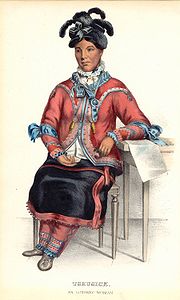
Plains Ojibwe Chief Sha-có-pay (The Six). In addition to the northern and eastern woodlands, Ojibwe people also lived on the prairies of Manitoba, Saskatchewan, Alberta, North Dakota, western Minnesota and Montana.
In British North America, the Royal Declaration of 1763 following the Vii Years' War governed the cession of country past treaty or purchase . Subsequently, France ceded most of the country in Upper Canada to Cracking United kingdom of great britain and northern ireland. Even with the Jay Treaty signed between Bully Uk and the United states of america post-obit the American Revolutionary State of war, the newly formed United States did non fully uphold the treaty. Every bit it was notwithstanding preoccupied past state of war with France, Great Britain ceded to the Usa much of the lands in Ohio, Indiana, Michigan, parts of Illinois and Wisconsin, and northern Minnesota and North Dakota to settle the boundary of their holdings in Canada.
In 1807, the Ojibwe joined three other tribes, the Odawa, Potawatomi and Wyandot people, in signing the Treaty of Detroit. The understanding, between the tribes and William Hull, representing the Michigan Territory, gave the United States a portion of today'due south Southeastern Michigan and a section of Ohio most the Maumee River. The tribes were able to retain small pockets of land in the territory.[23]
The Boxing of the Brule was an October 1842 battle between the La Pointe Band of Ojibwe Indians and a state of war party of Dakota Indians. The battle took place along the Brule River (Bois Brûlé) in what is today northern Wisconsin and resulted in a decisive victory for the Ojibwe.
In Canada, many of the land cession treaties the British made with the Ojibwe provided for their rights for continued hunting, fishing and gathering of natural resources after land sales. The regime signed numbered treaties in northwestern Ontario, Manitoba, Saskatchewan, and Alberta. British Columbia had non signed treaties until the late 20th century, and most areas have no treaties nonetheless. The government and First Nations are continuing to negotiate treaty land entitlements and settlements. The treaties are constantly beingness reinterpreted by the courts considering many of them are vague and difficult to utilise in modernistic times. The numbered treaties were some of the nearly detailed treaties signed for their time. The Ojibwe Nation gear up the calendar and negotiated the first numbered treaties before they would let condom passage of many more than British settlers to the prairies.
Ojibwe communities accept a strong history of political and social activism. Long before contact, they were closely aligned with Odawa and Potawatomi people in the Council of the Iii Fires. From the 1870s to 1938, the Grand General Indian Quango of Ontario attempted to reconcile multiple traditional models into one cohesive phonation to practise political influence over colonial legislation. In the West, sixteen Plains Cree and Ojibwe bands formed the Allied Bands of Qu'Appelle in 1910 in social club to redress concerns about the failure of the government to uphold Treaty 4's promises.
Civilization [edit]
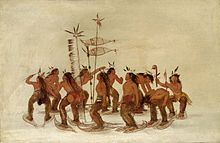
The Ojibwe have traditionally organized themselves into groups known as bands. Most Ojibwe, except for the Great Plains bands, have historically lived a settled (as opposed to nomadic) lifestyle, relying on fishing and hunting to supplement the tillage of numerous varieties of maize and squash, and the harvesting of manoomin (wild rice) for food. Historically their typical dwelling has been the wiigiwaam (wigwam), built either as a waginogaan (domed-order) or as a nasawa'ogaan (pointed-society), made of birch bark, juniper bark and willow saplings. In the gimmicky era, almost of the people alive in mod housing, but traditional structures are still used for special sites and events.
They have a culturally-specific form of pictorial writing, used in the religious rites of the Midewiwin and recorded on birch bark scrolls and possibly on rock. The many complex pictures on the sacred scrolls communicate much historical, geometrical, and mathematical knowledge. The utilize of petroforms, petroglyphs, and pictographs has been common throughout the Ojibwe traditional territories. Petroforms and medicine wheels have been used to teach important spiritual concepts, record astronomical events, and to use as a mnemonic device for certain stories and behavior. The script is nonetheless in employ, among traditional people likewise as among youth on social media.
Some ceremonies use the miigis beat (cowry vanquish), which is found naturally in distant coastal areas. Their utilise of such shells demonstrates there is a vast, longstanding trade network beyond the continent. The apply and trade of copper across the continent has also been proof of a large trading network that took place for thousands of years, every bit far back equally the Hopewell tradition. Certain types of rock used for spear and pointer heads accept as well been traded over big distances precontact.
During the summer months, the people attend jiingotamog for the spiritual and niimi'idimaa for a social gathering (powwows) at various reservations in the Anishinaabe-Aki (Anishinaabe Land). Many people still follow the traditional ways of harvesting wild rice, picking berries, hunting, making medicines, and making maple sugar.
The Ojibwe bury their expressionless in burying mounds. Many erect a jiibegamig or a "spirit-firm" over each mound. An historical burial mound would typically have a wooden marking, inscribed with the deceased's doodem (association sign). Because of the distinct features of these burials, Ojibwe graves have been ofttimes looted past grave robbers. In the The states, many Ojibwe communities safe-guard their burial mounds through the enforcement of the 1990 Native American Graves Protection and Repatriation Act.
Several Ojibwe bands in the United States cooperate in the Cracking Lakes Indian Fish & Wild fauna Commission, which manages the treaty hunting and fishing rights in the Lake Superior-Lake Michigan areas. The commission follows the directives of U.S. agencies to run several wilderness areas. Some Minnesota Ojibwe tribal councils cooperate in the 1854 Treaty Authority, which manages their treaty hunting and fishing rights in the Arrowhead Region. In Michigan, the Chippewa-Ottawa Resource Authorization manages the hunting, fishing and gathering rights almost Sault Ste. Marie, and the resources of the waters of lakes Michigan and Huron. In Canada, the Grand Council of Treaty No. 3 manages the Treaty 3 hunting and fishing rights related to the surface area effectually Lake of the Woods.
Cuisine [edit]

Wild rice harvesting - 1934

Vintage photo entitled, "Paul Buffalo and married woman parching wild rice at their camp" - 1934
At that place is renewed interest in nutritious eating amid the Ojibwe, who have been expanding community gardens in food deserts, and accept started a mobile kitchen to teach their communities about nutritious food preparation.[24] The traditional Native American diet was seasonally dependent on hunting, fishing and the foraging and farming of produce and grains. The modern diet has substituted some other types of food like frybread and "Indian tacos" in place of these traditionally prepared meals. The Native Americans loss of connection to their culture is part of the "quest to reconnect to their food traditions" sparking an involvement in traditional ingredients like wild rice, that is the official state grain of Minnesota and was function of the pre-colonial diet of the Ojibwe. Other staple foods of the Ojibwe were fish, maple saccharide, venison and corn. They grew beans, squash, corn and potatoes and foraged for blueberries, blackberries, choke cherries, raspberries, gooseberries and huckleberries. During the summertime game animals like deer, beaver, moose, goose, duck, rabbits and deport were hunted.[25] [26]
One traditional method of making granulated sugar known among the Anishinabe was to boil maple syrup until reduced and pour into a trough, where the rapidly cooling syrup was rapidly processed into maple sugar using wooden paddles.[27]
Kinship and association system [edit]
Traditionally, the Ojibwe had a patrilineal organisation, in which children were considered born to the male parent's clan.[28] For this reason, children with French or English fathers were considered outside the clan and Ojibwe society unless adopted by an Ojibwe male. They were sometimes referred to as "white" considering of their fathers, regardless if their mothers were Ojibwe, equally they had no official place in the Ojibwe social club. The people would shelter the adult female and her children, but they did non take the same identify in the culture as children born to Ojibwe fathers.
Ojibwe understanding of kinship is circuitous and includes the immediate family every bit well as extended family. It is considered a modified bifurcate merging kinship system. As with whatsoever bifurcate-merging kinship system, siblings generally share the aforementioned kinship term with parallel cousins because they are all office of the same association. The modified system allows for younger siblings to share the aforementioned kinship term with younger cross-cousins. Complication wanes further from the person'southward firsthand generation, but some complexity is retained with female relatives. For case, ninooshenh is "my female parent'south sister" or "my male parent's sister-in-law"—i.due east., my parallel-aunt, but also "my parent'southward female cross-cousin". Nifty-grandparents and older generations, also as nifty-grandchildren and younger generations, are collectively chosen aanikoobijigan. This organization of kinship reflects the Anishinaabe philosophy of interconnectedness and rest among all living generations, as well as of all generations of the past and of the future.
The Ojibwe people were divided into a number of doodemag (clans; atypical: doodem) named primarily for animals and birds totems (pronounced doodem). The discussion in the Ojibwe linguistic communication ways "my swain clansman."[29] The 5 original totems were Wawaazisii (Bullhead), Baswenaazhi ("Echo-maker", i.e., Crane), Aan'aawenh (Pintail Duck), Nooke ("Tender", i.eastward., Comport) and Moozwaanowe ("Little" Moose-tail). The Crane totem was the nearly song among the Ojibwe, and the Acquit was the largest – and then large, that it was sub-divided into trunk parts such as the head, the ribs and the feet. Each clan had certain responsibilities among the people. People had to ally a spouse from a different clan.
Traditionally, each band had a self-regulating council consisting of leaders of the communities' clans, or odoodemaan. The band was ofttimes identified by the chief doodem. In meeting others, the traditional greeting among the Ojibwe people is, "What is your 'doodem'?" ("Aaniin gidoodem?" or "Awanen gidoodem?") The response allows the parties to institute social deport by identifying as family unit, friends or enemies. Today, the greeting has been shortened to "Aanii " (pronounced "Ah-nee").[xxx]
Spiritual beliefs [edit]

Pictorial notation of an Ojibwe music lath

The Ojibwe have spiritual behavior that have been passed down by oral tradition under the Midewiwin teachings. These include a cosmos story and a recounting of the origins of ceremonies and rituals. Spiritual beliefs and rituals were very important to the Ojibwe because spirits guided them through life. Birch bawl scrolls and petroforms were used to laissez passer along knowledge and data, as well as for ceremonies. Pictographs were likewise used for ceremonies.
The sweatlodge is still used during important ceremonies almost the four directions, when oral history is recounted. Teaching lodges are mutual today to teach the next generations about the language and ancient means of the past. The traditional means, ideas, and teachings are preserved and practiced in such living ceremonies.
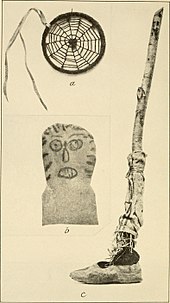
The modernistic dreamcatcher, adopted by the Pan-Indian Movement and New Historic period groups, originated in the Ojibwe "spider web charm",[31] a hoop with woven string or sinew meant to replicate a spider's web, used as a protective amuse for infants.[32] According to Ojibwe legend, the protective charms originate with the Spider Woman, known equally Asibikaashi; who takes intendance of the children and the people on the land and every bit the Ojibwe Nation spread to the corners of North America it became difficult for Asibikaashi to attain all the children, so the mothers and grandmothers wove webs for the children, which had an apotropaic purpose and were not explicitly connected with dreams.[32]
Funeral practices [edit]
Traditional [edit]
In Ojibwe tradition, the main task after a decease is to bury the torso as soon equally possible, the very adjacent mean solar day or even on the day of expiry. This was of import because information technology immune the spirit of the expressionless to journey to its place of joy and happiness. The land of happiness where the dead reside is called Gaagige Minawaanigozigiwining.[33] This was a journey that took iv days. If burying preparations could not exist completed the day of the expiry, guests and medicine men were required to stay with the deceased and the family in order to help mourn, while besides singing songs and dancing throughout the night. Once preparations were consummate, the body would be placed in an inflexed position with their knees towards their breast.[34] Over the form of the iv days it takes the spirit to journeying to its place of joy, it is customary to take food kept alongside the grave at all times. A fire is set up when the sun sets and is kept going throughout the nighttime. The food is to help feed the spirit over the course of the journeying, while the smoke from the fire is a directional guide. One time the iv 24-hour interval journey is over, a feast is held, which is led by the chief medicine homo. At the banquet, it is the chief medicine man'south duty to requite abroad sure property of the deceased. Those who were called to receive items from the deceased are required to trade in a new piece of clothing, all of which would be turned into a bundle. The packet of new cloths and a dish is then given to the closest relative. The recipient of the parcel must and so find individuals that he or she believes to be worthy, and pass on 1 of the new pieces of wear.[35]
Contemporary [edit]
According to Lee Staples, an Ojibwe spiritual leader from the Mille Lacs Indian Reservation, present day practices follow the same spiritual beliefs and remain fairly similar. When an individual dies, a burn down is lit in the home of the family, who are also expected to continuously maintain the fire for four days. Over the four days, food is too offered to the spirit. Added to food offerings, tobacco is also offered as information technology is considered one of four sacred medicines traditionally used by Ojibwe communities. On the last dark of nutrient offerings, a feast is also held by the relatives which ends with a final smoke of the offering tobacco or the tobacco being thrown in the burn. Although conventional caskets are mainly used in today's communities, birch bawl burn down matches are buried along with the body every bit a tool to aid light fires to guide their journeying to Gaagige Minawaanigozigiwining.[33]
Ethnobotany [edit]
![[icon]](https://upload.wikimedia.org/wikipedia/commons/thumb/1/1c/Wiki_letter_w_cropped.svg/20px-Wiki_letter_w_cropped.svg.png) | This department needs expansion. You can help by adding to it. (August 2013) |
Plants used by the Ojibwe include Agrimonia gryposepala, used for urinary bug,[36] and Pinus strobus, the resin of which was used to care for infections and gangrene. The roots of Symphyotrichum novae-angliae are smoked in pipes to attract game.[37] Allium tricoccum is eaten as part of Ojibwe cuisine.[38] They besides use a decoction as a quick-acting emetic.[39] An infusion of the alba subspecies of Silene latifolia is used equally physic.[forty] The South Ojibwa use a decoction of the root Viola canadensis for pains near the bladder.[41] The Ojibwa are documented to use the root of Uvularia grandiflora for hurting in the solar plexus, which may refer to pleurisy.[42] They accept a chemical compound decoction of the root of Ribes glandulosum for back pain and for "female weakness".[43] The Ojibwe eat the corms of Sagittaria cuneata for indigestion, and also every bit a nutrient, eaten boiled fresh, stale or candied with maple sugar. Muskrat and beavers store them in large caches, which they have learned to recognize and advisable.[44] They accept an infusion of the Antennaria howellii ssp. neodioica after childbirth to purge afterbirth and to heal.[45] They use the roots of Solidago rigida, using a decoction of root as an enema[46] and accept an infusion of the root for "stoppage of urine".[47] They use Abies balsamea; melting the gum on warm stones and inhaling the fumes for headache.[48] They also utilise a decoction of the root as an herbal steam for rheumatic joints.[48] They as well combine the gum with bear grease and apply it as an ointment for hair.[49] They use the needle-like leaves in as part of ceremony involving the sweatbath, and use the gum for colds and inhale the leaf smoke for colds.[50] They use the constitute as a cough medicine.[51] The glue is used for sores and a chemical compound containing leaves is used equally wash. The liquid balsam from bark blisters is used for sore eyes.[50] They eddy the resin twice and add together it to suet or fatty to brand a canoe pitch.[52] The bark gum is taken for chest soreness from colds, applied to cuts and sores, and decoction of the bark is used to induce sweating. The bark glue is besides taken for gonorrhea.[53] A decoction (tea) of powdered, dried Onoclea sensibilis root is used to stimulate milk flow in female patients.[54]
Gallery [edit]
-

Vintage stereoscopic photo entitled "Chippewa lodges, Beaver Bay, by Childs, B. F."
Bands [edit]
In his History of the Ojibway People (1855), William Westward. Warren recorded 10 major divisions of the Ojibwe in the U.s.. He mistakenly omitted the Ojibwe located in Michigan, western Minnesota and west, and all of Canada. When identified major historical bands located in Michigan and Ontario are added, the count becomes xv:[ citation needed ]
| English Name | Ojibwe Name (in double-vowel spelling) | Location |
|---|---|---|
| Saulteaux | Baawitigowininiwag | Sault Ste. Marie surface area of Ontario and Michigan |
| Border-Sitters | Biitan-akiing-enabijig | St. Croix-Namekagon River valleys in eastern Minnesota and northern Wisconsin |
| Lake Superior Band | Gichi-gamiwininiwag | south shore of Lake Superior |
| Mississippi River Band | Gichi-ziibiwininiwag | upper Mississippi River in Minnesota |
| Rainy Lake Ring | Goojijiwininiwag | Rainy Lake and River, about the northern boundary of Minnesota |
| Ricing-Track | Manoominikeshiinyag | forth headwaters of St. Croix River in Wisconsin and Minnesota |
| Pillagers | Makandwewininiwag | Northward-central Minnesota and Mississippi River headwaters |
| Mississaugas | Misi-zaagiwininiwag | north of Lake Erie, extending north of Lake Huron nigh the Mississaugi River |
| Dokis Band (Dokis'due south and Restoule'south bands) | N/A | Forth French River (Wemitigoj-Sibi) region (including Piddling French River (Ziibiins) and Restoule River) in Ontario, near Lake Nipissing |
| Ottawa Lake (Lac Courte Oreilles) Ring | Odaawaa-zaaga'iganiwininiwag | Lac Courte Oreilles, Wisconsin |
| Bois Forte Band | Zagaakwaandagowininiwag | north of Lake Superior |
| Lac du Flambeau Ring | Waaswaaganiwininiwag | caput of Wisconsin River |
| Muskrat Portage Band | Wazhashk-Onigamininiwag | northwest side of Lake Superior at the Canada–U.s. border |
| Nopeming Band | Noopiming Azhe-ininiwag | northeast of Lake Superior and west of Lake Nipissing |
These 15 major divisions developed into the following Ojibwe Bands and Get-go Nations of today. Bands are listed under their corresponding tribes where possible.[ citation needed ] Encounter also the listing of Saulteaux communities.
- Aamjiwnaang First Nation
- Aroland Commencement Nation
- Batchewana First Nation of Ojibways
- Bay Mills Indian Customs
- Biinjitiwabik Zaaging Anishnabek First Nation
- Burt Lake Ring of Chippewa and Ottawa Indians
- Caldwell Kickoff Nation
- Chapleau Ojibway First Nation
- Chippewas of Kettle and Stony Signal
- Chippewas of Lake Simcoe and Huron (Historical)
- Beausoleil First Nation
- Chippewas of Georgina Island First Nation
- Chippewas of Rama Starting time Nation (formerly known as Chippewas of Mnjikaning First Nation)
- Chippewas of Nawash Unceded Beginning Nation
- Chippewa of the Thames Starting time Nation
- Chippewas of Saugeen Ojibway Territory (Historical)
- Chippewas of Nawash Unceded Outset Nation
- Saugeen Get-go Nation
- Chippewa Cree Tribe of Rocky Boys Indian Reservation
- Curve Lake Showtime Nation
- Cutler First Nation
- Dokis First Nation
- Eabametoong Offset Nation
- Kickoff Nation of Ojibwe California
- Grand Traverse Band of Ottawa and Chippewa Indians
- Garden River Beginning Nation
- Henvey Inlet First Nation
- Grassy Narrows First Nation (Asabiinyashkosiwagong Nitam-Anishinaabeg)
- Islands in the Trent Waters
- Keeseekoowenin Ojibway Outset Nation (likewise known as Riding Mountain Band)
- Koocheching First Nation
- Lac des Mille Lacs Offset Nation
- Lac La Croix Start Nation
- Lac Seul Start Nation
- Lake Nipigon Ojibway Showtime Nation
- Lake Superior Chippewa Tribe
- Bad River Chippewa Ring
- Lac Vieux Desert Ring of Lake Superior Chippewa
- Keweenaw Bay Indian Customs
- L'Anse Ring of Chippewa Indians
- Ontonagon Band of Chippewa Indians
- Lac Courte Oreilles Band of Lake Superior Chippewa Indians
- Bois Brule River Band of Lake Superior Chippewa
- Chippewa River Band of Lake Superior Chippewa
- Lac Courte Oreilles Band of Lake Superior Chippewa Indians
- Removable St. Croix Chippewa Indians of Wisconsin
- Lac du Flambeau Ring of Lake Superior Chippewa
- Red Cliff Ring of Lake Superior Chippewa
- Sokaogon Chippewa Community
- St. Croix Chippewa Indians of Wisconsin
- Little Beat Tribe of Chippewa Indians of Montana
- Little Traverse Bay Bands of Odawa Indians
- Mackinac Bands of Chippewa and Ottawa Indians
- Magnetawan First Nation
- Minnesota Chippewa Tribe
- Bois Forte Band of Chippewa
- Bois Forte Band of Chippewa
- Lake Vermilion Band of Lake Superior Chippewa
- Little Forks Band of Rainy River Saulteaux
- Fond du Lac Ring of Lake Superior Chippewa
- Grand Portage Band of Chippewa
- Leech Lake Band of Ojibwe
- Cass Lake Band of Chippewa
- Lake Winnibigoshish Ring of Chippewa
- Leech Lake Band of Pillagers
- Removable Lake Superior Bands of Chippewa of the Chippewa Reservation
- White Oak Signal Band of Mississippi Chippewa
- Pokegama Lake Band of Mississippi Chippewa
- Removable Sandy Lake Band of Mississippi Chippewa
- Mille Lacs Ring of Ojibwe
- Mille Lacs Indians
- Sandy Lake Band of Mississippi Chippewa
- Rice Lake Band of Mississippi Chippewa
- St. Croix Band of Chippewa Indians of Minnesota
- Kettle River Band of Chippewa Indians
- Snake and Pocketknife Rivers Band of Chippewa Indians
- White World Band of Chippewa
- Gull Lake Band of Mississippi Chippewa
- Otter Tail Band of Pillagers
- Rabbit Lake Ring of Mississippi Chippewa
- Removable Mille Lacs Indians
- Rice Lake Ring of Mississippi Chippewa
- Bois Forte Band of Chippewa
- Mississaugi First Nation
- North Caribou Lake First Nation
- Ojibway Nation of Saugeen First Nation
- Ojibways of the Pic River First Nation
- Osnaburg House Ring of Ojibway and Cree (Historical)
- Cat Lake Offset Nation
- Mishkeegogamang Kickoff Nation (formerly known as New Osnaburgh First Nation)
- Slate Falls First Nation
- Pembina Ring of Chippewa Indians (Historical)
- Pikangikum Offset Nation
- Poplar Loma First Nation
- Red Lake Band of Chippewa Indians
- Lac des Bois Band of Chippewa Indians
- Rolling River First Nation
- Sagamok Anishnawbek First Nation
- Saginaw Chippewa Tribal Council
- Sault Tribe of Chippewa Indians
- Saulteaux First Nation
- Shawanaga First Nation
- Southeast Tribal Council
- Berens River First Nation
- Bloodvein Starting time Nation
- Brokenhead First Nation
- Buffalo Point First Nation (Saulteaux)
- Hollow H2o First Nation
- Black River First Nation
- Lilliputian Thousand Rapids First Nation
- Pauingassi First Nation (Saulteaux)
- Poplar River First Nation
- Turtle Mount Band of Chippewa Indians
- Wabaseemoong Contained Nation
- Wabauskang First Nation
- Wabun Tribal Council
- Beaverhouse First Nation
- Brunswick House First Nation
- Chapleau Ojibwe Get-go Nation
- Matachewan Offset Nation
- Mattagami First Nation
- Wahgoshig Outset Nation
- Wabigoon Lake Ojibway Nation
- Wahnapitae First Nation
- Walpole Island Get-go Nation
- Washagamis Bay Get-go Nation
- Whitefish Bay Starting time Nation
- Whitefish Lake First Nation
- Whitefish River First Nation
- Whitesand Kickoff Nation
- Whitewater Lake First Nation
- Wikwemikong Unceded Kickoff Nation
Notable historic Ojibwe people [edit]
Ojibwe people from the 20th and 21st centuries should exist listed under their specific tribes.
- Ah-shah-way-gee-she-become-qua (Aazhawigiizhigokwe, Hanging Cloud), 19th c. Lac Courte Oreilles Ojibwe woman warrior
- Francis Assikinack (1824–1863), historian from Manitoulin Island
- Stephen Bonga, Ojibwe/African-American fur trader and interpreter[55]
- George Bonga (1802–1880), Ojibwe/African-American fur trader and interpreter
- Jeanne L'Strange Cappel (1873–1949), writer, instructor and clubwoman
- George Copway (1818–1869), missionary and writer
- Fr. Philip B. Gordon (1885–1948), Roman Cosmic priest and activist from Gordon, Wisconsin
- Margaret Bonga Fahlstrom (c.1797–1880), Ojibwe-African American woman in the early on Methodist Episcopal Church building in Minnesota
- Hole in the Twenty-four hour period (1825-1868), Main of the Mississippi Band of the Minnesota Ojibwe
- Peter Jones (1802–1856), Mississauga missionary and author
- Kechewaishke (Gichi-Weshkiinh, Buffalo) (ca. 1759–1855), principal
- Edmonia Lewis (ca. 1844–1907), Mississauga Ojibwe/African-American sculptor
- Maungwudaus, George Henry (1811–1888), performer, interpreter, mission worker, and herbalist
- Medweganoonind, 19th-century Ruby-red Lake Ojibwe chief
- Ozaawindib (Ozaawindib, Yellowish Caput), early 19th c. nonbinary warrior, guide
- Keewaydinoquay Peschel (1919–1999), instructor, ethnobotanist
- Main Rocky Boy (fl. late 19th c.), chief
- Jane Johnston Schoolcraft (1800–1842), author, wife of Henry Rowe Schoolcraft, born in Sault Ste. Marie
- John Smith, Gaa-binagwiiyaas (ca. 1824–1922, primary, from Cass Lake, Minnesota
- Alfred Michael "Chief" Venne (1879–1971), athletic manager and jitney from Leroy, Northward Dakota
- Waabaanakwad (White Cloud) (ca. 1830-1898), Gull Lake primary
- William Whipple Warren (1825–1853), first historical writer of the Ojibwe people, territorial legislator
- Zheewegonab (fl. 1780–1805), band leader among the northern Ojibwe
- Cara Gee (1983-), Canadian actress
- Trixie Mattel (1989-), American drag queen[56]
Ojibwe treaties [edit]
- Chippewa Ottawa Resource Authority—1836CT fisheries
- Grand Quango of Treaty 3—Treaty 3
- 1000 Quango of Treaty 8—Treaty 8
- Peachy Lakes Indian Fish & Wildlife Commission—1837CT, 1836CT, 1842CT and 1854CT
- Nishnawbe Aski Nation—Treaty 5 and Treaty 9
- Red Lake Band of Chippewa—1886CT and 1889CT
- Union of Ontario Indians—RS, RH1, RH2, misc. pre-confederation treaties
- Treaties with France
- La Grande Paix de Montréal (1701)
- Treaties with Great Britain and the U.k.
- Treaty of Fort Niagara (1764)
- Treaty of Fort Niagara (1781)
- Indian Officers' Land Treaty (1783)
- The Crawford Purchases (1783)
- Betwixt the Lakes Purchase (1784)
- Treaty of Peace with Sioux, Chippewa and Winnebago (1787)
- Toronto Purchase (1787)
- Indenture to the Toronto Buy (1805)
- The McKee Purchase (1790)
- Between the Lakes Buy (1792)
- Chenail Ecarte (Sombra Township) Purchase (1796)
- London Township Purchase (1796)
- Land for Joseph Brant (1797)
- Penetanguishene Bay Purchase (1798)
- St. Joseph Island (1798)
- Caput-of-the-Lake Purchase (1806)
- Lake Simcoe-Lake Huron Buy (1815)
- Lake Simcoe-Nottawasaga Purchase (1818)
- Ajetance Purchase (1818)
- Rice Lake Purchase (1818)
- The Rideau Purchase (1819)
- Long Forest Purchase (1822)
- Huron Tract Purchase (1827)
- Saugeen Tract Agreement (1836)
- Manitoulin Agreement (1836)
- The Robinson Treaties
- Ojibewa Indians of Lake Superior (1850)
- Ojibewa Indians of Lake Huron (1850)
- Manitoulin Isle Treaty (1862)
- Treaties with Canada
- Treaty No. 1 (1871)—Stone Fort Treaty
- Treaty No. 2 (1871)
- Treaty No. 3 (1873)—Northwest Angle Treaty
- Treaty No. 4 (1874)—Qu'Appelle Treaty
- Treaty No. 5 (1875)
- Treaty No. half dozen (1876)
- Treaty No. viii (1899)
- Treaty No. ix (1905–1906)—James Bay Treaty
- Treaty No. 5, Adhesions (1908–1910)
- The Williams Treaties (1923)
- The Chippewa Indians
- The Mississauga Indians
- Treaty No. 9, Adhesions (1929–1930)
- Treaties with the United states of america
- Treaty of Fort McIntosh (1785)
- Treaty of Fort Harmar (1789)
- Treaty of Greenville (1795)
- Fort Industry (1805)
- Treaty of Detroit (1807)
- Treaty of Brownstown (1808)
- Treaty of Springwells (1815)
- Treaty of St. Louis (1816)—Ottawa, Ojibwe, and Potawatomi
- Treaty of Miami Rapids (1817)
- Treaty of St. Mary's (1818)
- Treaty of Saginaw (1819)
- Treaty of Saúlt Ste. Marie (1820)
- Treaty of L'Arbre Croche and Michilimackinac (1820)
- Treaty of Chicago (1821)
- Get-go Treaty of Prairie du Chien (1825)
- Treaty of Fond du Lac (1826)
- Treaty of Butte des Morts (1827)
- Treaty of Green Bay (1828)
- 2d Treaty of Prairie du Chien (1829)
- Treaty of Chicago (1833)
- Treaty of Washington (1836)—Ottawa & Chippewa
- Treaty of Washington (1836)—Swan Creek & Black River Bands
- Treaty of Detroit (1837)
- Treaty of St. Peters (1837)—White Pine Treaty
- Treaty of Flint River (1837)
- Saganaw Treaties
- Treaty of Saganaw (1838)
- Supplemental Treaty (1839)
- Treaty of La Pointe (1842)—Copper Treaty
- Isle Royale Agreement (1844)
- Treaty of Potawatomi Creek (1846)
- Treaty of Fond du Lac (1847)
- Treaty of Leech Lake (1847)
- Treaty of La Pointe (1854)
- Treaty of Washington (1855)
- Treaty of Detroit (1855)—Ottawa & Chippewa
- Treaty of Detroit (1855)—Sault Ste. Marie Band
- Treaty of Detroit (1855)—Swan Creek & Black River Bands
- Treaty of Sac and Play a trick on Agency (1859)
- Treaty of Washington (1863)
- Treaty of Sometime Crossing (1863)
- Treaty of Sometime Crossing (1864)
- Treaty of Washington (1864)
- Treaty of Isabella Reservation (1864)
- Treaty of Washington (1866)
- Treaty of Washington (1867)
Gallery [edit]
-

Bosom of Beshekee, state of war chief, modeled 1855, carved 1856
-
-

-

Leech Lake Ojibwe delegation to Washington, 1899
-

Chippewa baby teething on "Indians at Work" mag while strapped to a cradleboard at a rice lake in 1940.
-

-

-

-
-

Primary medicine homo Axel Pasey and family at Yard Portage Minnesota.
-

Historic 1849 petition of Ojibwe chiefs
-
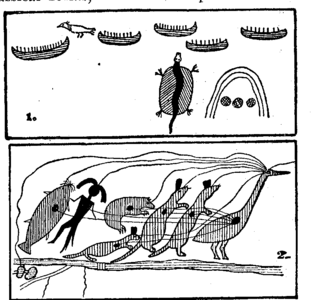
Wells American Indian pic writing
See also [edit]
- Amikwa people
- Offset Nations
- Timeline of Starting time Nations history
- History of Native Americans in the The states
- Native Americans in the United States
References [edit]
Notes [edit]
- ^ a b "CDC – American – Indian – Alaska – Native – Populations – Racial – Indigenous – Minorities – Minority Wellness". two December 2012. Archived from the original on 2 December 2012.
{{cite web}}: CS1 maint: bot: original URL status unknown (link) - ^ a b "Ojibwe – The Canadian Encyclopedia".
- ^ Spencer, Kelly (August 31, 2020). "The rock carvings of Kinoomaagewaabkong". Norfolk & Tillsonburg News . Retrieved January 31, 2021.
{{cite news}}: CS1 maint: url-condition (link) - ^ "BEACH HOUSE – MYTH". YouTube. Archived from the original on 2018-06-30.
- ^ "Science Buzz".
- ^ "Anishinabe". eMuseum @ Minnesota State University. Minnesota State Academy. Mankato. Archived from the original on 2010-04-09. Retrieved 2010-03-16 .
- ^ "Ojibwe | The Canadian Encyclopedia". www.thecanadianencyclopedia.ca . Retrieved 2021-01-31 .
- ^ "Batchewana – History". batchewana.ca . Retrieved 2021-01-31 .
- ^ "Microsoft Give-and-take – dictionary best for printing 2004 ever finalpdf.doc" (PDF) . Retrieved 2011-01-02 .
- ^ Warren, William W. (1885; reprint: 1984) History of the Ojibway People. ISBN 0-87351-162-X
- ^ Louise Erdrich, Books and Islands in Ojibwe Country (2003) Archived September 26, 2007, at the Wayback Machine
- ^ Johnston, Basil. (2007) Anishinaubae Thesaurus ISBN 0-87013-753-0
- ^ Iii Fires Unity: The Anishnaabeg of the Lake Huron Borderlands. Phil Bellfy. 2011. Academy of Nebraska.
- ^ "Beginning Nations Culture Areas Index". the Canadian Museum of Civilisation.
- ^ "Anishinaabemowin: Ojibwe Language | The Canadian Encyclopedia". www.thecanadianencyclopedia.ca . Retrieved 2021-01-31 .
- ^ Roy, Loriene. "Ojibwa". Countries and Their Cultures . Retrieved 9 August 2016.
- ^ Anthony, David. The Horse, the Wheel and Linguistic communication, Princeton University Press, 2007, p. 102
- ^ "Conversations on Reconciliation: "Tiotiá:ke and Mooniyaang: Country Acknowledgement."". Onishka. Montréal. six June 2017 – via Indigenous Contemporary Scene.
- ^ Schmalz, Peter (May 1992). "The Ojibwa of southern Ontario". Histoire Sociale / Social History . Retrieved i September 2018.
- ^ "The Atlas of Canada: Historical Indian Treaties". Retrieved March ane, 2018.
- ^ Gevinson, Alan. "Which Native American Tribes Allied Themselves with the French?". www.teachinghistory.org . Retrieved 23 September 2011.
- ^ James A. Clifton, "Wisconsin Death March: Explaining the Extremes in Sometime Northwest Indian Removal", in Transactions of the Wisconsin Academy of Sciences, Arts and Letters, 1987, 5:i–xl, accessed ii March 2010
- ^ "Treaty Between the Ottawa, Chippewa, Wyandot, and Potawatomi Indians". World Digital Library. 1807-11-17. Retrieved 2013-08-03 .
- ^ "In tribes across Minnesota, ethnic nutrient movement takes root". Star Tribune.
- ^ "Eating indigenously changes diets and lives of Native Americans".
- ^ "Anishinabe".
- ^ Child, Brenda J. (16 Feb 2012). Belongings Our World Together: Ojibwe Women and the Survival of Customs. ISBN9781101560259.
- ^ "Ojibwe Civilisation" Archived 2015-06-23 at the Wayback Motorcar, Milwaukee Public Museum, accessed 10 December 2011
- ^ Billard, Jules, B. (1989). "North. Scott Momaday "I am Alive ..."". The World of the American Indian, A volume in the Story of Man Library. Washington, D.C. p. 13. ISBN08707447998.
- ^ Squad, Forvo. "Aanii pronunciation: How to pronounce Aanii in Ojibwa". Forvo.com . Retrieved 2021-03-07 .
- ^ Jim Keen Elk Waters (2002), View from the Medicine Lodge, Vii Locks Press, p. 111.
- ^ a b Densmore, Frances (1929, 1979) Chippewa Customs. Minn. Hist. Soc. Press; pg. 113.
- ^ a b Allis, Ellary. "The Spirit of The Expressionless According To Ojibwe Beliefs." SevenPonds, 7 Ponds, 8 Dec. 2016, weblog.sevenponds.com/cultural-perspectives/the-spirit-of-the-dead-co-ordinate-to-ojibwe-beliefs.
- ^ Hilger, M. Inez (1944), Chippewa Burial and Mourning Community. American Anthropologist, 46: 564–568. doi:10.1525/aa.1944.46.4.02a00240
- ^ James A. Clifton, "Wisconsin Expiry March: Explaining the Extremes in Old Northwest Indian Removal", in Transactions of the Wisconsin Academy of Sciences, Arts and Letters, 1987, 5:1–40
- ^ Daniel E. Moerman (2009). Native American Medicinal Plants: An Ethnobotanical Lexicon . Timber Press. pp. 52–53. ISBN978-0-88192-987-4.
- ^ Densmore, Frances 1928 Uses of Plants past the Chippewa Indians. SI-BAE Annual Report #44:273–379 (p. 376)
- ^ Smith, Huron H. 1933 Ethnobotany of the Forest Potawatomi Indians. Bulletin of the Public Museum of the City of Milwaukee 7:one–230 (p. 104)
- ^ Densmore, Frances 1928 Uses of Plants past the Chippewa Indians. SI-BAE Almanac Report #44:273–379 (p. 346)
- ^ Smith, Huron H. 1932 Ethnobotany of the Ojibwe Indians. Bulletin of the Public Museum of Milwaukee four:327–525 (p. 361)
- ^ Hoffman, W.J., 1891, The Midewiwin or 'Grand Medicine Lodge' of the Ojibwa, SI-BAE Annual Report #7, folio 201
- ^ Smith, Huron H., 1932, Ethnobotany of the Ojibwe Indians, Bulletin of the Public Museum of Milwaukee 4:327–525, page 374
- ^ Densmore, Frances 1928 Uses of Plants by the Chippewa Indians. SI-BAE Annual Study #44:273–379 (p. 356)
- ^ Smith, Huron H., 1932, Ethnobotany of the Ojibwe Indians, Bulletin of the Public Museum of Milwaukee 4:327–525, page 396
- ^ Smith, Huron H., 1932, Ethnobotany of the Ojibwe Indians, Bulletin of the Public Museum of Milwaukee iv:327–525, page 363
- ^ Densmore, Frances, 1928, Uses of Plants by the Chippewa Indians, SI-BAE Annual Written report #44:273–379, folio 364 (Note: This source comes from the Native American ethnobotany database <http://naeb.brit.org/> which lists the plant as Oligoneuron rigidum var. rigidum.) Accessed 19 January 2018
- ^ Densmore, Frances, 1928, Uses of Plants by the Chippewa Indians, SI-BAE Annual Report #44:273–379, page 348 (Note: This source comes from the Native American ethnobotany database <http://naeb.brit.org/> which lists the plant equally Oligoneuron rigidum var. rigidum). Accessed 19 January 2018
- ^ a b Densmore, Frances, 1928, Uses of Plants by the Chippewa Indians, SI-BAE Almanac Report #44:273–379, page 338
- ^ Densmore, Frances, 1928, Uses of Plants by the Chippewa Indians, SI-BAE Annual Study #44:273–379, page 350
- ^ a b Smith, Huron H., 1932, Ethnobotany of the Ojibwe Indians, Bulletin of the Public Museum of Milwaukee iv:327–525, page 378
- ^ Reagan, Albert B., 1928, Plants Used past the Bois Fort Chippewa (Ojibwa) Indians of Minnesota, Wisconsin Archeologist vii(4):230–248, page 244
- ^ Smith, Huron H., 1932, Ethnobotany of the Ojibwe Indians, Bulletin of the Public Museum of Milwaukee 4:327–525, page 420
- ^ Hoffman, W.J., 1891, The Midewiwin or 'Grand Medicine Order' of the Ojibwa, SI-BAE Almanac Report #7, page 198
- ^ Smith, Huron H., 1932, Ethnobotany of the Ojibwe Indians, Bulletin of the Public Museum of Milwaukee 4:327–525, page 382
- ^ "Portrait of Stephen Bonga", Wisconsin Historical Images, accessed 23 January 2014
- ^ "Q&A: Trixie Mattel". 8 September 2015.
Bibliography [edit]
- F. Densmore, Chippewa Customs (1929, repr. 1970)
- H. Hickerson, The Chippewa and Their Neighbors (1970)
- R. Landes, Ojibwa Sociology (1937, repr. 1969)
- R. Landes, Ojibwa Woman (1938, repr. 1971)
- F. Symington, The Canadian Indian (1969)
Farther reading [edit]
- Aaniin Ekidong: Ojibwe Vocabulary Project. St. Paul: Minnesota Humanities Center, 2009
- Bento-Banai, Edward (2004). Creation- From the Ojibwa. The Mishomis Volume.
- Child, Brenda J. (2014). My Grandfather'south Knocking Sticks: Ojibwe Family Life and Labor on the Reservation. St. Paul, MN: Minnesota Historical Order Printing.
- Danziger, E.J., Jr. (1978). The Chippewa of Lake Superior. Norman: University of Oklahoma Printing.
- Denial, Catherine J. (2013). Making Marriage: Husbands, Wives, and the American Land in Dakota and Ojibwe Country. St. Paul, MN: Minnesota Historical Society Press.
- Densmore, F. (1979). Chippewa customs. St. Paul: Minnesota Historical Social club Press. (Published originally 1929)
- Grim, J.A. (1983). The shaman: Patterns of religious healing amidst the Ojibway Indians. Norman: Academy of Oklahoma Press.
- Gross, Fifty.West. (2002). The comic vision of Anishinaabe culture and religion. American Indian Quarterly, 26, 436–459.
- Howse, Joseph. A Grammar of the Cree Language; With which is combined an analysis of the Chippeway dialect. London: J.1000.F. & J. Rivington, 1844.
- Johnston, B. (1976). Ojibway heritage. Toronto: McClelland and Stewart.
- Long, J. Voyages and Travels of an Indian Interpreter and Trader Describing the Manners and Customs of the N American Indians, with an Business relationship of the Posts Situated on the River Saint Laurence, Lake Ontario, & C., to Which Is Added a Vocabulary of the Chippeway Linguistic communication ... a List of Words in the Iroquois, Mehegan, Shawanee, and Esquimeaux Tongues, and a Table, Shewing the Illustration between the Algonkin and the Chippeway Languages. London: Robson, 1791.
- Nichols, J.D., & Nyholm, Eastward. (1995). A concise dictionary of Minnesota Ojibwe. Minneapolis: University of Minnesota Printing.
- Treuer, Anton. Everything You Wanted to Know Near Indians Only Were Afraid to Inquire. St. Paul: Minnesota Historical Club Press, 2012.
- Treuer, Anton. The Assassination of Hole in the Day. St. Paul: Minnesota Historical Gild Press, 2011.
- Treuer, Anton. Ojibwe in Minnesota. St. Paul: Minnesota Historical Society, 2010. Ojibwe in Minnesota. St. Paul: Minnesota Historical Society Press, 2010.
- Treuer, Anton. Living Our Language: Ojibwe Tales & Oral Histories. St. Paul: Minnesota Historical Lodge Press, 2001.
- Vizenor, G. (1972). The everlasting sky: New voices from the people named the Chippewa. New York: Crowell-Collier Printing.
- Vizenor, G. (1981). Summer in the spring: Ojibwe lyric poems and tribal stories. Minneapolis: The Nodin Press.
- Vizenor, Chiliad. (1984). The people named the Chippewa: Narrative histories. Minneapolis: University of Minnesota Press.
- Warren, William W. (1851). History of the Ojibway People.
- White, Richard (1991). The Middle Footing: Indians, Empires, and Republics in the Great Lakes Region, 1650–1815 (Studies in N American Indian History) Cambridge University Press, Cambridge, England.
- White, Richard (July 31, 2000). Chippewas of the Sault. The Sault Tribe News.
- Wub-due east-ke-niew. (1995). We have the right to exist: A translation of aboriginal ethnic idea. New York: Black Thistle Press.
External links [edit]
 | Wikimedia Eatables has media related to Ojibwe. |
 | Wikiquote has quotations related to: Ojibwe |
- Ojibwe Vocal Pictures, recorded by Frances Desmore
- Ojibwe People'south Dictionary
- Ojibwe Waasa-Inaabidaa—PBS documentary featuring the history and culture of the Anishinaabe-Ojibwe people of the Great Lakes (United States–focused).
- Ojibwe migratory map from Ojibwe Waasa-Inaabidaa
- Batchewana Starting time Nation of Ojibways
- Red Cliff Band of Lake Superior Chippewa
- Mississaugi First Nation
- Southeast Tribal Council
- Wabun Tribal Council
- Ojibwe Stories: Gaganoonididaa from the Public Radio Exchange
dunningtheatelf48.blogspot.com
Source: https://en.wikipedia.org/wiki/Ojibwe
0 Response to "Ojibwe Art Ojibwe Art How Did They Make Weapons"
Post a Comment