Sherman Alexie Reading the Exaggeration of Despair
| Sherman Alexie | |
|---|---|
 Alexie in 2016 | |
| Born | (1966-10-07) October 7, 1966 Spokane, Washington, U.S |
| Occupation |
|
| Nationality | Spokane Coeur d'Alene American |
| Genre | Native American literature, humour, documentary fiction |
| Literary move | Indigenous Nationalism |
| Notable works | • The Admittedly Truthful Diary of a Part-Time Indian • Fume Signals • Reservation Dejection • The Alone Ranger and Tonto Fistfight in Sky • You Don't Accept to Say Yous Love Me: A Memoir • War Dances |
| Notable awards | American Book Accolade 1996 National Volume Award 2010 |
| Website | |
| fallsapart | |
Sherman Joseph Alexie Jr. (built-in October seven, 1966) is a Spokane-Coeur d'Alene-Native American novelist, short story writer, poet, and filmmaker. His writings describe on his experiences every bit an Indigenous American with ancestry from several tribes. He grew up on the Spokane Indian Reservation and now lives in Seattle, Washington.[i]
His best-known book is The Lonely Ranger and Tonto Fistfight in Heaven (1993), a collection of short stories. It was adapted as the film Smoke Signals (1998), for which he also wrote the screenplay.
His kickoff novel, Reservation Blues, received a 1996 American Book Award.[2] His kickoff young adult novel, The Absolutely Truthful Diary of a Part-Time Indian (2007), is a semi-autobiographical novel that won the 2007 U.S. National Volume Honour for Young People's Literature[iii] and the Odyssey Award as all-time 2008 audiobook for young people (read by Alexie).[4] His 2009 drove of curt stories and poems, War Dances, won the 2010 PEN/Faulkner Award for Fiction.[5]
Alexie is the guest editor of the 2015 Best American Poetry.
In 2018 he was accused of sexual harassment by multiple women.
Early life [edit]
Alexie was born on October 7, 1966,[half dozen] at Sacred Heart Infirmary in Spokane, Washington. Every bit a kid he lived on the Spokane Indian Reservation, located west of Spokane.[7] His father, Sherman Joseph Alexie, was a member of the Coeur d'Alene tribe, and his female parent, Lillian Agnes Cox, was of Colville, Choctaw, Spokane and European American ancestry.[8] Ane of his paternal great-grandfathers was of Russian descent.[9] Alexie was born with hydrocephalus, a condition that occurs when there is an abnormally large amount of cognitive fluid in the brain'south ventricular system.[10] He had to accept brain surgery when he was six months old, and was at high risk of death or mental disabilities if he survived.[8] Alexie's surgery was successful; he suffered no mental damage but had other side effects.[10]
His parents were alcoholics, though his mother achieved sobriety. His father often left the house on drinking binges for days at a time. To support her six children, Alexie'south mother, Lillian, sewed quilts, worked every bit a clerk at the Wellpinit Trading Post, and had another jobs.[10]
Alexie has described his life at the reservation schoolhouse as challenging, as he was constantly teased by other kids and endured abuse he described every bit "torture" from white nuns who taught in that location. They called him "The Globe" because his caput was larger than usual, due to suffering hydrocephalus equally an babe. Until the age of seven, Alexie suffered from seizures and bedwetting; he had to accept strong drugs to control them.[ten] Because of his health bug, he was excluded from many of the activities that are rites of passage for young Indian males.[11] Alexie excelled academically, reading everything available, including auto repair manuals.[12]
Education [edit]
In order to better his education, Alexie decided to go out the reservation and attend high school in Reardan, Washington.,[10] 22 miles from the reservation, and where Alexie was the only Native American student.[11] He excelled at his studies and became a star histrion on the basketball team, the Reardan High Schoolhouse Indians.[10] He was elected grade president and was a member of the fence team.[x]
His successes in high schoolhouse won him a scholarship in 1985 to Gonzaga University, a Roman Catholic academy in Spokane.[10] [11] Originally, Alexie enrolled in the pre-med plan with hopes of condign a doctor,[11] simply found he was squeamish during autopsy in his anatomy classes.[11] Alexie switched to law, but constitute that was not suitable, either.[11] He felt enormous force per unit area to succeed in college, and consequently, he began drinking heavily to cope with his anxiety.[xiii] Unhappy with police, Alexie found condolement in literature classes.[11]
In 1987, he dropped out of Gonzaga and enrolled in Washington State University (WSU),[11] where he took a creative writing grade taught by Alex Kuo, a respected poet of Chinese-American background. Alexie was at a low point in his life, and Kuo served as a mentor to him.[8] Kuo gave Alexie an anthology entitled Songs of This Earth on Turtle's Back, past Joseph Bruchac. Alexie said this book inverse his life as it taught him "how to connect to not-Native literature in a new fashion".[8] [11] [fourteen] He was inspired past reading works of poetry written past Native Americans.[8]
Sexual harassment allegations [edit]
On February 28, 2018, Alexie published a statement regarding accusations of sexual harassment against him past several women, including author Litsa Dremousis, with whom he had a consensual thing in the by and who claimed numerous women had spoken to her about Alexie'due south behavior.[xv] Alexie admitted he had "harmed" other people besides Dremousis. Dremousis'due south response initially appeared on her Facebook page and was subsequently reprinted in The Stranger on March 1, 2018.[xvi] The allegations against Alexie were detailed in an NPR story v days later.[17] NPR corroborated the sexual harassment allegations of three other women. The fallout from these accusations includes the Found of American Indian Arts renaming its Sherman Alexie Scholarship equally the MFA Alumni Scholarship. The web log Native Americans in Children's Literature has deleted or modified all references to Alexie.[18] In February 2018 it was reported that the American Library Association, which had just awarded Alexie its Carnegie Medal for Y'all Don't Have to Say You lot Dearest Me: A Memoir,[19] was reconsidering, and in March it was confirmed that Alexie had declined the honor and was postponing the publication of a paperback version of the memoir.[20] The American Indian Library Association rescinded its 2008 Best Young Developed Book Laurels from Alexie for The Admittedly True Diary of a Part-Time Indian, "to send an unequivocal message that Alexie's actions are unacceptable."[21]
Career [edit]
Alexie published his outset collection of poetry, The Business organization of Fancydancing: Stories and Poems, in 1992 through Hanging Loose Press.[8] [22] With that success, Alexie stopped drinking and quit school just three credits short of a degree. However, in 1995, he was awarded an honorary bachelor's degree from Washington State University.[11]
In 2005, Alexie became a founding board fellow member of Longhouse Media, a non-turn a profit organization that is committed to instruction filmmaking skills to Native American youth and using media for cultural expression and social change. Alexie has long supported youth programs and initiatives defended to supporting at-risk Native youth.[23]
Literary works [edit]
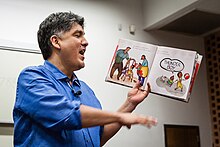
Alexie's stories have been included in several short story anthologies, including The Best American Curt Stories 2004, edited past Lorrie Moore; and Pushcart Prize XXIX of the Small-scale Presses. Additionally, a number of his pieces take been published in various literary magazines and journals, too equally online publications.
Themes [edit]
Alexie'south poetry, brusk stories and novels explore themes of despair, poverty, violence and alcoholism among the lives of Native American people, both on and off the reservation. They are lightened by wit and humor.[13] According to Sarah A. Quirk from the Dictionary of Library Biography, Alexie asks three questions across all of his works: "What does it mean to live as an Indian in this fourth dimension? What does it mean to be an Indian man? Finally, what does it mean to live on an Indian reservation?"[8] The protagonists in most of his literary works showroom a abiding struggle with themselves and their ain sense of powerlessness in white American order.[13]
Poetry [edit]
Within a yr of graduating from college, Alexie received the Washington State Arts Committee Poetry Fellowship and the National Endowment for the Arts Poesy Fellowship.[24] His career began with the publishing of his first ii collections of verse in 1992, entitled, I Would Steal Horses and The Business of Fancydancing. [viii] In these poems, Alexie uses humor to express the struggles of contemporary Indians on reservations. Common themes include alcoholism, poverty and racism.[eight] Although he uses humor to express his feelings, the underlying message is very serious. Alexie was awarded The Republic of chad Walsh Poetry Prize past the Beloit Poetry Journal in 1995.
The Business of Fancydancing: Stories and Poems (1992) [25] was well received, selling over 10,000 copies.[11] Alexie refers to his writing as "fancydancing,"[12] a flashy, colorful style of competitive Pow wow dancing. Whereas older, traditional forms of Indian trip the light fantastic toe may be ceremonial and kept private among tribal members, the fancydance style was created by Native American veterans from World War 2 every bit a form of public entertainment.[12] Alexie compares the mental, emotional, and spiritual outlet that he finds in his writings to the brilliant self-expression of the dancers.[thirteen] Leslie Ullman commented on The Concern of Fancydancing in the Kenyon Review, writing that Alexie "weaves a curiously soft-blended tapestry of humor, humility, pride and metaphysical provocation out of the difficult realities...: the tin can-shack lives, the alcohol dreams, the bad luck and caricatural disasters, and the self-subversive courage of his characters."[13]
Alexie'south other collections of poetry include:
- The Business of Fancydancing: Stories and Poems (1992)
- Onetime Shirts and New Skins (1993)[13]
- First Indian on the Moon (1993)[xiii]
- Seven Mourning Songs For the Cedar Flute I Accept All the same to Learn to Play (1994)[13]
- H2o Flowing Domicile (1996)[13]
- The Summer of Black Widows (1996)[13]
- The Man Who Loves Salmon (1998)[xiii]
- Ane Stick Song (2000)[thirteen]
- Face (2009), Hanging Loose Printing (April 15, 2009) hardcover, 160 pages, ISBN 978-i-931236-71-iii [13]
Brusk stories [edit]
Alexie published his offset prose work, entitled The Solitary Ranger and Tonto Fistfight in Heaven, in 1993.[eight] The book consists of a series of short stories that are interconnected. Several prominent characters are explored, and they have been featured in later works by Alexie. According to Sarah A. Quirk, The Alone Ranger and Tonto Fistfight in Heaven can be considered a bildungsroman with dual protagonists, "Victor Joseph and Thomas Builds-the-Burn, moving from relative innocence to a mature level on experience."[eight]
Ten Little Indians (2004) is a collection of "nine extraordinary short stories ready in and around the Seattle expanse, featuring Spokane Indians from all walks of urban life," according to Christine C. Menefee of the School Library Journal.[thirteen] In this collection, Alexie "challenges stereotypes that whites have of Native Americans and at the same time shows the Native American characters coming to terms with their own identities."[xiii]
War Dances is a drove of brusk stories, poems, and curt works. It won the 2010 PEN/Faulkner Honour for Fiction. The collection, nevertheless, received mixed reviews.[thirteen]
Other short stories by Alexie include:
- Superman and Me (1997)
- The Toughest Indian in the Earth (2000) (collection of curt stories)[26]
- "What Y'all Pawn I Will Redeem" (2003), published in The New Yorker [27]
- Blasphemy: New and Selected Stories (2012)[28]
- "Because My Begetter Ever Said He Was the Merely Indian Who Saw Jimi Hendrix Play 'The Star−Spangled Imprint' at Woodstock"
Novels [edit]
In his kickoff novel, Reservation Dejection (1995), Alexie revisits some of the characters from The Solitary Ranger and Tonto Fistfight in Heaven. Thomas Builds-the-Fire, Victor Joseph, and Junior Polatkin, who accept grown up together on the Spokane Indian reservation, were teenagers in the short story collection. In Reservation Dejection they are now adult men in their thirties.[29] Some of them are now musicians and in a band together. Verlyn Klinkenborg of the Los Angeles Times wrote in a 1995 review of Reservation Blues: "you lot can experience Alexie'due south purposely divided attending, his alertness to a divided audition, Native American and Anglo."[29] Klinkenborg says that Alexie is "willing to risk didacticism whenever he stops to explicate the particulars of the Spokane and, more broadly, the Native American experience to his readers."[29]
Indian Killer (1996) is a murder mystery set among Native American adults in contemporary Seattle, where the characters struggle with urban life, mental wellness, and the cognition that there is a serial killer on the loose. Characters deal with the racism in the Academy organization, too as in the community at large, where Indians are subjected to being lectured well-nigh their ain civilization by white professors who are really ignorant of Indian cultures.[thirteen]
Alexie's young adult novel, The Admittedly True Diary of a Part-Time Indian (2007) is a coming-of-historic period story that began as a memoir of his life and family on the Spokane Indian reservation.[13] The novel focuses on a fourteen-year-one-time Indian named Arnold Spirit. The novel is semi-autobiographical, including many events and elements of Alexie's life.[13] For case, Arnold was built-in with hydrocephalus, and was teased a lot every bit a child. The story also portrays events after Arnold'due south transfer to Reardan Loftier School, which Alexie attended.[13] The novel received great reviews and continues to be a summit seller. Bruce Barcott from the New York Times Volume Review observed, "Working in the voice of a 14-year-old forces Alexie to strip everything down to action and emotion, and so that reading becomes more than like listening to your smart, funny best friend recount his day while waiting after schoolhouse for a ride dwelling."[13]
Flying (2007) likewise features an adolescent protagonist. The narrator, who calls himself "Zits," is a fifteen-year-old orphan of mixed Native and European beginnings who has bounced around the foster organization in Seattle. The novel explores experiences of the by, equally Zits experiences short windows into others' lives afterwards he believes to be shot while committing a crime.[13]
Memoir [edit]
Alexie'due south memoir, Y'all Don't Have to Say You Dearest Me, was released by Hachette in June 2017.[30] Claudia Rowe of The Seattle Times wrote in June 2017 that the memoir "pulls readers and so deeply into the author's youth on the Spokane Indian Reservation that most will forget all about facile comparisons and simply surrender to Alexie's unmistakable patois of humor and profanity, history and pathos."[31] Alexie cancelled his book bout in support of You lot Don't Accept to Say You Love Me in July 2017 due to the emotional cost that promoting the volume was taking. In September 2017, he decided to resume the tour, with some significant changes. Equally he related to Laurie Hertzel of The Star Tribune, "I'm not performing the book," he said. "I'm getting interviewed. That's a whole unlike thing." He went on to add that he won't be answering any questions that he doesn't desire to answer. "I'll put my armor dorsum on," he said.[32]
Films [edit]
In 1998 Alexie's flick, Fume Signals gained considerable attention.[thirteen] Alexie based the screenplay on his brusque story drove, The Solitary Ranger and Tonto Fistfight in Heaven, and characters and events from a number of Alexie's works make appearances in the motion picture.[13] The film was directed by Chris Eyre, (Cheyenne-Arapaho) with a predominantly Native American product team and bandage.[11] The film is a route flick and buddy movie, featuring two immature Indians, Victor Joseph (Adam Beach) and Thomas Builds the Fire (Evan Adams), who exit the reservation on a road trip to recall the torso of Victor's expressionless father (Gary Farmer).[13] During their journey the characters' childhood is explored via flashbacks. The movie took top honors at the Sundance Film Festival.[13] It received an 86% and "fresh" rating from the online picture database Rotten Tomatoes.[33]
The Business of Fancydancing, written and directed by Alexie in 2002, explores themes of Indian identity, gay identity, cultural involvement vs blood breakthrough, living on the reservation or off it, and other issues related to what makes someone a "real Indian." The championship refers to the protagonist'southward choice to exit the reservation and make his living performing for predominantly-white audiences. Evan Adams, who plays Thomas Builds the Fire in "Smoke Signals", over again stars, now equally an urban gay man with a white partner. The death of a peer brings the protagonist home to the reservation, where he reunites with his friends from his childhood and youth. The picture show is unique in that Alexie hired an almost completely female crew to produce the moving-picture show. Many of the actors improvised their dialogue, based on real events in their lives. Information technology received a 57% and "rotten" rating from the online Film database Rotten Tomatoes.[34]
Other motion picture projects include:
- 49? (writer, 2003)[ commendation needed ]
- The Exiles (presenter, 2008)[ citation needed ]
- Sonicsgate (participant, 2009)
Bibliography [edit]
Poetry [edit]
Collections [edit]
- The Business of Fancydancing: Stories and Poems (1992)
- Old Shirts and New Skins (1993)
- Start Indian on the Moon (1993)
- Seven Mourning Songs For the Cedar Flute I Have Yet to Larn to Play (1994)
- Water Flowing Home (1996)
- The Summer of Black Widows (1996)
- The Man Who Loves Salmon (1998)
- Ane Stick Vocal (2000)
- Confront (2009), Hanging Loose Printing (April fifteen, 2009) hardcover, 160 pages, ISBN 978-1-931236-71-3
- Hymn (2017)
Uncollected poems [edit]
| Title | Twelvemonth | Showtime published | Reprinted/collected | Notes |
|---|---|---|---|---|
| 10-four | 2011 | Alexie, Sherman (Feb 23, 2011). "10-4" (PDF). Narrative Mag (Fall 2011). Archived from the original on Feb 27, 2019. | ||
| Double Wit | 2011 | Alexie, Sherman (Feb 23, 2011). "Double Wit" (PDF). Narrative Magazine (Fall 2011). Archived from the original on February 27, 2019. | ||
| Sasquatch Exposes the American Caste System | 2011 | Alexie, Sherman (February 23, 2011). "Sasquatch Exposes the American Caste System" (PDF). Narrative Magazine (Fall 2011). Archived from the original on February 27, 2019. | ||
| 16D | 2011 | Alexie, Sherman. "16D". Narrative Magazine (Poems of the Week: 2010–2011). | ||
| In'din Curse | 2012 | Alexie, Sherman (March 29, 2011). "In'din Curse". Narrative Mag (Winter 2012). | ||
| Autopsy | 2017 | Alexie, Sherman (January 31, 2017). "Dissection". Early Bird Books. | ||
| Hymn | 2017 | Alexie, Sherman (Baronial 16, 2017). "Hymn". Early on Bird Books. |
Memoir [edit]
- You Don't Have to Say You lot Love Me (2017), Hachette Book Grouping, ISBN 9780316396776.
Novels [edit]
- Reservation Dejection (1995)
- Indian Killer (1996)
- The Absolutely True Diary of a Part-Time Indian (2007)
- Flying (2007)
Brusk fiction [edit]
Collections [edit]
- The Lonely Ranger and Tonto Fistfight in Heaven (1993)
- The Toughest Indian in the World (2000)
- Ten Piddling Indians (2004)
- War Dances (2009)
- Blasphemy: New and Selected Stories (2012)
List of short stories [edit]
| Championship | Year | Starting time published | Reprinted/nerveless | Notes |
|---|---|---|---|---|
| Superman and Me | 1997 | Alexie, Sherman (April nineteen, 1998). "Superman and Me". The Los Angeles Times. | ||
| What You lot Pawn I Will Redeem | 2003 | Alexie, Sherman (April 21, 2003). "What You Pawn I Volition Redeem". The New Yorker. | Best American Short Stories 2004 | |
| The Human Comedy | 2010 | Alexie, Sherman (Feb 2010). "The Homo Comedy". Narrative Magazine (Autumn 2010). | A half-dozen-word story. | |
| Idolatry | 2011 | Alexie, Sherman (February 3, 2010). "Idolatry". Narrative Magazine (Spring 2011). | ||
| A Strange Solar day in July | 2011 | The Chronicles of Harris Burdick: 14 Amazing Authors Tell the Tales | ||
| Murder-Suicide | 2012 | Alexie, Sherman (April viii, 2011). "Murder-Suicide". Narrative Magazine (Winter 2012). | A six-word story. | |
| Happy Trails | 2013 | Alexie, Sherman (June x–17, 2013). "Happy Trails". The New Yorker. Vol. 89, no. 17. pp. 64–65. | ||
| The Human Comedy Part II | 2016 | Alexie, Sherman (September 22, 2015). "The Man One-act Political party II". Narrative Mag (Wintertime 2016). | A half-dozen-word story. | |
| Make clean, Cleaner, Cleanest | 2017 | Alexie, Sherman (April 21, 2003). "Clean, Cleaner, Cleanest". The New Yorker. | ||
| A Vacuum Is a Space Entirely Devoid of Matter | 2017 | Alexie, Sherman (July 11, 2017). "A Vacuum Is a Space Entirely Devoid of Thing". Narrative Magazine (Fall 2017). |
Children'due south books [edit]
- Thunder Boy, Jr. (2016), illustrated by Yuyi Morales
Personal life [edit]
Alexie is married to Diane Tomhave, who is of Hidatsa, Ho-Chunk and Potawatomi heritage. They live in Seattle with their two sons.[22]
Arizona HB 2281 [edit]
In 2012, Arizona's HB 2281 removed Alexie's works, along with those of others, from Arizona school curriculum. Alexie's response:
Permit's get one affair out of the manner: Mexican immigration is an oxymoron. Mexicans are indigenous. And so, in a foreign way, I'chiliad pleased that the racist folks of Arizona have officially alleged, in banning me alongside Urrea, Baca, and Castillo, that their anti-immigration laws are likewise anti-Indian. I'm likewise strangely pleased that the folks of Arizona accept officially announced their fear of an educated underclass. You give those brown kids some books most brown folks and what happens? Those brown kids change the world. In the effort to vanish our books, Arizona has actually given them enormous ability. Arizona has fabricated our books sacred documents now. [35]
Influences [edit]
Alexie'due south writings are meant to evoke sadness, but at the same time, he uses humor and popular culture that leave the readers with a sense of respect, agreement, and pity.[13] Alexie's influences for his literary works practice not rely solely on traditional Indian forms. He "blends elements of popular civilization, Indian spirituality, and the drudgery of poverty-ridden reservation life to create his characters and the earth they inhabit," according to Quirk.[8] Alexie'southward work is laced with oftentimes startling sense of humor. According to Quirk, he does this every bit a "means of cultural survival for American Indians—survival in the face up of the larger American culture's stereotypes of American Indians and their concomitant distillation of private tribal characteristics into i pan-Indian consciousness."[8]
Awards and honors [edit]
- 1992
- National Endowment for the Arts Poetry Fellowship
- 1993
- PEN/Hemingway Award for Best Start Volume of Fiction for the story collection The Lone Ranger and Tonto Fistfight in Sky [8]
- 1994
- Lila Wallace-Reader's Digest Writers' Award[8]
- 1996
- American Book Award (Before Columbus Foundation) for Reservation Blues [2]
- Granta Mag: Twenty Best American Novelists Under the Age of twoscore
- New York Times Notable Book for Indian Killer
- People Magazine: Best of Pages
- 1999
- The New Yorker: 20 Writers for the 21st Century
- 2001
- PEN/Malamud Laurels
- 2007
- National Volume Award, Immature People's Literature, for The Absolutely Truthful Diary of a Part-Fourth dimension Indian [3]
- 2009
- American Library Association Odyssey Honor every bit the year's "best audiobook for children or young adults", read by Alexie (Frederick, MD: Recorded Books, LLC, 2008, ISBN 1-4361-2490-5)[4]
- 2010
- PEN/Faulkner Award for War Dances [five]
- Native Writers' Circle of the Americas Lifetime Achievement Laurels
- Puterbaugh Award ", the first American Puterbaugh young man
- California Young Reader Medal for The Absolutely True Diary of a Part-Time Indian [36]
- 2013
- The John Dos Passos Prize for Literature [37]
See also [edit]
- List of writers from peoples indigenous to the Americas
- Louise Erdrich
- Native American Renaissance
- Native American studies
- At that place There (novel)
References [edit]
- ^ Konigsberg, Eric (October xx, 2009). "In His Own Literary World, a Native Son Without Borders". The New York Times. New York Urban center. Retrieved July one, 2018.
- ^ a b American Booksellers Clan (2013). "The American Volume Awards / Earlier Columbus Foundation [1980–2012]". BookWeb. Archived from the original on March 13, 2013. Retrieved September 25, 2013.
1996 [...] Reservation Blues, Sherman Alexie
- ^ a b "National Volume Awards – 2007". National Book Foundation (NBF). Retrieved 2012-04-xv.
(With acceptance spoken communication past Alexie, interview with Alexie, and other textile, partly replicated for all five Young People's Literature authors and books.) - ^ a b "Odyssey Accolade winners and honor audiobooks, 2008–present". ALSC. ALA. Retrieved 2012-04-19.
- ^ a b Trescott, Jacqueline (March 24, 2010). "Sherman Alexie wins 2010 Pen/Faulkner fiction prize for State of war Dances". The Washington Postal service. Washington DC: Nash Holdings LLC. Retrieved March 12, 2012.
- ^ Johansen, Bruce E. (2010). Native Americans Today: A Biographical Lexicon . Santa Barbara, Calif.: Greenwood Press. pp. 7–10. ISBN978-0-313-35554-seven.
- ^ Nourr, Sarah (October seven, 2013). "Happy Altogether, Sherman Alexie". The Arts Partnership . Retrieved March thirteen, 2015.
- ^ a b c d eastward f g h i j m fifty m n o Quirk, Sarah A. (2003). "Sherman Alexie (vii October 1966–)". Dictionary of Literary Biography. 7th. 278: 3–10. Retrieved April 7, 2012. [ permanent expressionless link ]
- ^ Alexie, Sherman (May 27, 2012). "@Sherman_Alexie: Elizabeth Warren is as close to her Indian ancestors equally I am to my 19th-century Russian fur-trapping great-grandpa". Twitter. Archived from the original on October 1, 2013. Retrieved April 11, 2018.
- ^ a b c d e f g h Cline, Lynn (2000). "Virtually Sherman Alexie". Ploughshares. 26 (4): 197. Retrieved January 15, 2016.
- ^ a b c d e f g h i j m 50 m "Sherman Alexie". Authors and Artists for Immature Adults. 28. 1999. Retrieved April 8, 2012. [ permanent dead link ]
- ^ a b c "Sherman Alexie". Encyclopedia of Globe Biography. 1998. Retrieved April viii, 2012. [ permanent expressionless link ]
- ^ a b c d due east f grand h i j chiliad 50 m n o p q r southward t u v w ten y z aa "Sherman Alexie". Authors and Artists for Young Adults. 85. 2011. Retrieved April 5, 2012. [ permanent dead link ]
- ^ "A Conversation With Sherman Alexie". Blue Mesa Review. December half dozen, 2012. Retrieved April 2, 2013.
- ^ Sherman Alexie Statement contributed past Shirley Qiu, Seattle Times. Dated Feb 28, 2018.
- ^ Smith, Rich (March 1, 2018). "Litsa Dremousis Responds to Sherman Alexie's Statement". The Stranger. Seattle, Washington: Index Newspapers, LLC. Retrieved July 1, 2018.
- ^ Neary, Lynn (March 5, 2018). "'It But Felt Very Wrong': Sherman Alexie'southward Accusers Become On The Record". NPR. Retrieved October 13, 2020.
- ^ Gupta, Prachi (February 27, 2018). "Native American Lit Community Warns of Sexual Harassment Allegations Against Sherman Alexie". Jezebel . Retrieved July 1, 2018.
- ^ "'Manhattan Embankment,' 'You Don't Have to Say You Love Me,' receive 2018 Andrew Carnegie Medals for Excellence in Fiction and Nonfiction". ALA News. February xiv, 2018. Retrieved July 1, 2018.
- ^ Schilling, Vincent (March nineteen, 2018). "Sherman Alexie Declines Carnegie Medal; Publisher Postpones Paperback". Indian Land Today. Washington DC: National Congress of American Indians. Retrieved July 1, 2018.
- ^ Yorio, Kara (March 21, 2018). "'AILA Rescinds Sherman Alexie'due south 2008 YA Book of the Year Honor'". Schoolhouse Library Journal. New York City: Media Source Inc. Retrieved July 1, 2018.
- ^ a b Official Sherman Alexie website Archived June 2, 2011, at the Wayback Machine
- ^ "About U.s.: What is Longhouse Media?". Longhouse Media. Archived from the original on July 2, 2010. Retrieved July one, 2018.
- ^ Ettlinger, Marian. "Sherman Alexie". Salem Printing. Archived from the original on April 14, 2013. Retrieved 2013-04-02 .
- ^ Sanders, Ken (June half-dozen, 1992). "The Business of Fancydancing - Stories and Poems (1992) Volume Appraisement; Ken Sanders Rare Books, Salt Lake City, UT". Antiques Roadshow.
- ^ Ponca Stock, Alexandra (January 19, 2018). "Musings on Sherman Alexie's the Toughest Indian in the Earth". Medium.com. New York Metropolis: A Medium Corporation. Retrieved July 1, 2018.
- ^ Alexie, Sherman (Apr 21, 2003). "What You Have I Will Redeem". The New Yorker. New York City: Condé Nast. Retrieved July 1, 2018.
- ^ Row, Jess (Nov 21, 2012). "Without Reservation: 'Blasphemy,' by Sherman Alexie". The New York Times. New York Metropolis. Retrieved November 25, 2011.
- ^ a b c Klinkenborg, Verlyn (June 18, 1995). "America at the Crossroads: Life on the Spokane Reservation". Los Angeles Times Book Review . Retrieved April 5, 2012. [ permanent expressionless link ]
- ^ Alexie, Sherman (June 13, 2017). Yous Don't Have to Say Y'all Dearest Me. Hachette Book Group. ISBN9780316396776 . Retrieved June 21, 2017.
- ^ "Sherman Alexie's brave new memoir delves into his babyhood". The Seattle Times. June xix, 2017. Retrieved June 21, 2017.
- ^ "Writer Sherman Alexie is back on the road: 'I averted a crunch'". Star Tribune . Retrieved December 6, 2017.
- ^ "Smoke Signals". Rotten Tomatoes . Retrieved April 2, 2013.
- ^ "Search Results - Rotten Tomatoes". Rotten Tomatoes.
- ^ rdsathene, "Sherman Alexie "Arizona has made our books sacred documents at present." Daily Kos, Feb one, 2012.
- ^ "Winners". California Immature Reader Medal. Archived from the original on May 27, 2011. Retrieved May viii, 2011.
- ^ "Past Recipients and Select Works". Longwood University. Retrieved Oct 5, 2017.
- Other sources
- Alexie, Sherman; Neb Clinton and Jim Lehrer. "A Dialogue on Race with President Clinton". News Hour. July 9, 1998.
- Nygren, Åse. "A World of Story-Fume: A Conversation with Sherman Alexie." MELUS 30.4 (Wintertime 2005): 149–69.
- Westward, Dennis, and Joan M. West. ""Sending Cinematic Smoke Signals: An Interview with Sherman Alexie". Cineaste 23.4 (Fall 1998): 29–33.
External links and further reading [edit]
- Western American Literature Journal: Sherman Alexie
- Official website
- Sherman Alexie at the Cyberspace Speculative Fiction Database
- Sherman Alexie at IMDb
- Voice of the New Tribes article by Duncan Campbell in "The Guardian" January 3, 2003
- Sherman Alexie's poem "Punch" in Gulf Coast: A Journal of Literature and Fine Arts (24.one).
- Berglund, Jeff and Jan Roush, eds. Sherman Alexie: A Collection of Critical Essays, (2010) ISBN 978-1-60781-008-7.
- Sherman Alexie at Library of Congress Authorities, with 26 itemize records
- Appearances on C-Bridge
- Sherman Alexie's heartbreaking reason for pausing his book tour - via KUOW News and Information
- Interviews
- "Sherman Alexie" past Robert Capriccioso, Identity Theory, published March 23, 2003
- "Sherman Alexie" by Joelle Fraser, Iowa Review, copyright 2001
- "Northwest Passages: Sherman Alexie" by Emily Harris, Think Out Loud, Oregon Public Broadcasting, broadcast October 8, 2009
- "Interview With Sherman Alexie" every bit 2007 National Volume Accolade winner, by Rita Williams-Garcia
- "No More Playing Dead for American Indian Filmmaker Sherman Alexie" past Rita Kempley, The Washington Mail, July 3, 1998
- "Sherman Alexie on Living Outside Cultural Borders" by Bill Moyers, circulate April 12, 2013 – with "Dig Deeper" on Alexie's life, work, and influence
dunningtheatelf48.blogspot.com
Source: https://en.wikipedia.org/wiki/Sherman_Alexie
0 Response to "Sherman Alexie Reading the Exaggeration of Despair"
Post a Comment